Wednesday, 3 March 2010

Euphemia in Mensa

The following article first appeared in March 2010 Mensa Magazine

From Tending Toddlers to Committing Murder


Caroline Dunford

October 2009 saw the release of my first crime novel, A Death in the Family: A Euphemia Martins Mystery. Previously I’d been most well known for a book I published documenting the second year in the life of my toddler (now 8). So what causes a mother writing about her challenging child to turn to crime?

It’s a good and a difficult question. It’s right up there with the perennial favourite of readers ‘how do you get your ideas?’ All writers hate that question not because they think it’s a foolish one, but if we’re honest, because we rarely know.

I can say that the traumas, heightened emotions and constant tension required of a murder mystery aren’t that different to being the main carer of a toddler (and last February I made myself another one.) But it’s really more about how I approached both topics that gives me my signature style. If some murder mysteries are best drunk with a glass of whisky by your side to fortify you against the more visceral moments, my murder mystery is best read in a comfy chair with a cup of tea and a nice biscuit. I hope on occasion my readers will be nibbling their nails nervously, but I also expect them to snort tea down their nose from laughing so hard.

It’s taken me a very long time to discover my writing style. The somewhat quirky take on life that I initially developed as a personal survival device against a constantly bemusing world turns out to be also the best way for me to tell stories. Euphemia is set in 1910 and behind the laughter and the headstrong (often naïve) antics of the eighteen year old heroine the books confront the very real differences of class, gender and the incoming storm-clouds of WW1.

The story of how Euphemia came into being is even less straight forward. I heard from a fellow writer that ePrint Publishing, previously an educational materials only publisher, was looking for writers of thrillers and mysteries for their new Read Away imprint. My sense of the market told me this was not an opportunity to be missed. I contacted them at once and asked if I could submit. I was politely told they were seeking prospective work from among their already large stable of authors. I pleaded that one had referred me and was allowed to send a chapter and synopsis, but it would need to be delivered in a matter of weeks.

I went to bed wracking my brains trying to think how I could make a science-fiction thriller appeal to a wide audience and woke up with the idea of the Euphemia Martins Mysteries – which are light historical crime stories with a nod to Agatha Christie and Jane Austen in style. My subconscious clearly has a better insight into the literary market than my waking mind.

Euphemia Martins might have been created literally over night, but she had an extremely long gestation period. She is partly inspired by my great grandmother, who came from a very wealthy family, but on falling out with her new-step mother, ran away from home and into service. And so a family legend was born.

Although I never met her as a child I loved her story. It sounded so romantic. As an adult I realized her life was more likely to have been hard and difficult, but I admired her enormously for her independent spirit in a time when women were of very little account.

My switch to crime becomes even easier to understand when you know that like most Mensans I love puzzles and I love crime novels. I’d never written one because I don’t know (or particularly want to know) a lot about either forensics or police procedure. However, in 1910 forensics were very limited and by making my investigation team a maid and the younger son of rich, but disreputable family, I’ve almost entirely side-stepped the police. My background in psychotherapy helps me create three dimensional characters and also gives me a good grounding in what will drive a person to murder.

I heard Euphemia’s voice from the first sentence of chapter one and I knew I had something special. Fortunately ePrint agreed and before book one was even completed we were talking about the series. My crime writing is now an established part of my life and the family know the tell-tale signs of when I am disappearing back into 1910. Books two and three (‘A Death in the Highlands’ and ‘A Death in the Asylum’) are scheduled for release this year and book one has just been entered into the Orange Prize.

A Death in the Family: A Euphemia Martins Mystery (ePrint Publishing) is available now in paperback (£6.99) from the publisher’s website http://www.readaway.co.uk/, http://www.amazon.co.uk/ and from all good bookstores.

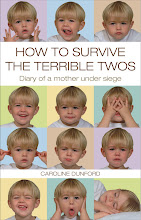
How to Survive the Terrible Twos: Diary of a mother under siege (£7.99) available direct from http://www.crimsonpublishing.co.uk/, http://www.amazon.co.uk/ and from all good bookstores,

Wednesday, 20 January 2010

Toddling On

Between 2003 and 2004 I kept a diary on the progress of my elder son's toddler years. In particular the times that are known for a good reason as The Terrible Twos. This went on to form the basis of the book How to Survive the Terrible Twos: diary of a mother under siege which was published in September 2005.

Of course no child is terrible, but all mothers discover that this particular stage of growing mobility and independence is a time when small people test boundaries to see if anything, including their parents, will break. It is also a delightful time. On the whole toddlers are great companions, endlessly amusingly, mostly deliriously happy (when not in tantrum mode) and full of the joys of life. Mortgages, school, job worries, finances etc play no part in their little worlds. The journey of a toy train around the living room is the funniest, best and most exciting thing ever and will produce endless gales of laughter. When you are able to engage in this positive tiny worldview it is extremely refreshing. The problem has always been that parents worry if they are doing the right thing and there are countless professionals on hand to tell them how to manage their child - very few of whom agree or who set unachievablely high standards.

I wrote The Terrible Twos as a mother not an expert. I wrote of all my mistakes as well as my achievements. It's funny and it's sad, but above all I hope it's hopeful and reassuring.

This morning, despite the book being five years old, I saw that another review had been added to the amazon site by a mother who had come across the book by chance and found it helpful. I know it's a very popular book in libraries and is recommended by a number of councils in their parental help section.

The child in the book is now eight and thriving. His little brother is just coming up for two. I may need to reread my own book.

Thursday, 7 January 2010

Real life and fiction

Fiction may be inspired by life, but it's far from playing by the same rules. Life is to fiction as a riding a penny farthing is to driving a lamborghini. It's bigger, brighter, more thrilling and you get there very much sooner.

It is most easy to see this on t.v. How many times have you seen a character sit down for a coffee or a meal only to rise again in moments as if this was perfectly normal? When in reality you know everyone in the place would be looking at them as if they were mad and their lack of nourishment would mean they would expire within a few weeks?

Characters in fiction eat fast, rarely sleep and certainly never sh- go to the toilet. A few shower, because that's apparently a very good place for them to have unique thoughts and it allows a little flesh to be shown/imaged.

And characters never travel from A to B. They depart and they arrive. The journey is only described if something happens along the way.

Coincidence is seen as lazy writing. Critics will mutter about plot threads not being woven tightly enough and the gods defend any new writer who sends material to the slush pile that can be seen as in any way baggy. And yet it's very real. If you think back over the past twenty four hours I bet you'll be able to come up with one minor coincidence and over the past month as least one major one. (Try it!)

Ironically, anti-coincidence - like my recently swapping my 4x4 for one of the most ecologically friendly cars on the planet and investing in my first decent pair of high heels for years just before the snow-storm came - would be fine to be used in a story. It would be seen as humorous and creating more obstacles for my character (which it has.)

This is what fiction is all about - characters vaulting or crashing into obstacles (literally or figuratively). In the west where life moves at an ever increasing pace, so our fiction has got faster and faster. Paragraphs are shorter on the page and scenes fleeting on the telly. I'm told people watch tv, text and surf the net at the same time. (It makes me wonder if the next stage of evolution will involve more hands.) As has been noted for some time our attention span is continually shrinking.

The golden rule in modern writing is stuff has to happen and it has to happen now! It also has to play by the rules of fictional life. These, as you will be gathering, are many, varied and illogical.

And yet all rules can be broken if you can do it in a way that shocks the reader. Shock being one of the most tantalizing enticements to bored readers. Fear and horror are very acceptable too. Although the whisper from the States is the next new vogue in publishing will be Angels as the general reader base is looking for a bit of cheering stuff. (Thank heavens)

If I try to make sense of this all the best I can offer is that when we tell someone of our day's events, we don't put in all the details. We highlight stuff and if we want to keep their attention we do our best to surprise, intrigue and perhaps even shock. We want to seem interesting and we want our fiction in the same flavor.


Thursday, 17 December 2009

Work ethics and disappointment

Part of the problem of having a professional blog is that you tend to try and post the worthy stuff only. This can lead to either a very dull blog or a empty blog or in the worst cases both. Mine has certainly been on the sparse side for a while.

However, I have not been inactive otherwise. As well as the all the midwinter festivities many of us are preparing for I have also started the third Euphemia Martins novel. (It will be out in October 2010). It's rolling along nicely with Euphemia, as well intentioned as ever, tumbling into one escapade after another. However, with each novel she is growing just that bit more savvy.

But the real reason I find myself writing up my blog this morning is due to my unexpected freedom. Yesterday I worked extra hard and in between many and varied necessary trips I wrote an entire draft chapter, instead of my usual half. The theory being I'd free myself up for a no writing day and go and spend the morning instead with my writerly pal Z and his daughter. We are in the same writers group and have attempted to meet up several times independently (and with toddlers) for coffee before and always been thwarted. Today the heavens opened, icy blasts rained down and there is as Z put it 'the wrath of god' falling on his side of the city.
So, we're not meeting. Panda, the toddler, is pleased as he is very sleepy. (He took ages to settle last night and due to holding a one bear party in his cot.) I can of course now knuckle down to some more work. Only I don't feel much like it. I worked hard for my treat today and I feel as disappointed as a toddler who's just learned there are no more biscuits in the jar. (Or in Panda's case no more bananas - have I said how much the bear loves bananas?) I am going to get a hot cup of tea and some croissants and watch something really bad that I taped earlier and see what I feel like. Doubtless I will do some more work today, but it will feel better if I convince myself I don't have to.

If it's cold and miserable where you are take a look at my publisher's new website. Not only is there a roaring fire, but there's even a cat on the rug. You can feel warm just looking at it!

Wednesday, 18 November 2009

Startled but pleased.

My publisher has decided to enter A Death in the Family into the Orange Fiction prize! I am a little startled, but very pleased.

Wednesday, 11 November 2009

Google who?

In general writers are shy folk. There will always be some who prefer to swing naked from the trees while tap-tapping on their lap-tops, but for most of us writing is a solitary exercise undertaken through the necessity of preserving our sanity. Writers are observers. We record what we experience. We take life and jumble it up with fantasy and feelings and whatever else we have lying around at the time and then we present is tentatively to the reading public. It's often quoted that writers hold up a mirror to society, but I suspect many of them, like me, are writing to try and make sense of the world around them.

There are just so many things that don't make sense from why egg-whites go into the oven gooey and come out rock hard to the evolution of the duck billed platypus; from why a strange large lorry reverses up my dead-end lane every morning to who actually recorded the 'Stand Clear Vehicle Reserving' jingle that it loudly plays. Or why do my computer and my iPhone think it's okay to offer me entirely different calendars despite being synced or why is the weather always best when there's a deadline to be completed? And then there are the serious things that essentially all come down to why on earth do people think it's okay to hurt each other?

The wonderful thing about the internet is that it is proof positive that a lot of people out there are asking the same questions and lots of people are trying to answer them. Saying the resources on the internet are big is rather like describing the universe as being a nice little collection of stars. Who runs the internet and who feeds in all this data is a bit of a mystery. Could it be a giant army of elves of which the QI elves are the only ones to formally declare themselves?

Some of the information has bylines and even photos though you can never be entirely sure that anyone you meet or read on the internet is a) real or b) exactly what they seem to be. In a similar way you can never be sure that any of the data you find is accurate.

You'd think then that the internet was a great way for us shy authors to self publicize and to some extent it is. Social media from twitter to twirl from facebook to lj all offer us a way to reach potential readers. If we put in enough time and effort we get pages of listing on google . In fact from time to time things will be picked up and posted without any action on our behalf. My reading from A Death in the Family appeared over on The Witty Sparks blog without my lifting a finger. Someone has been also posting my performed plays on a couple of websites though they rarely seem to get the list right and appear to have borrowed the photo from my blog. They also have my nationality wrong, but it's clear it's all done with the best of intentions.

Some ebook authors on the other hand have the misfortune to find their entire works downloadable for free - presumably on sites created by people who don't understand that some of us earn a living from generating content and that giving it away for free it rather like us breaking into their houses and helping ourselves to a toaster or a telly because we rather like it.

All in all this means that the internet is at heart a reflection of humanity and therefore liable to be wildly contradictory and often misleading. The one certain thing is whatever you put out there stays out there. Googling myself recently (and there's a verb I wasn't taught in school) Caroline Dunford for the first five pages of hits is entirely me. In fact it's mostly me for the first nine pages. I think this is quite impressive - try it with your own name and see what comes up.


Friday, 30 October 2009

But what's it all about?

On my to-write list at present is the third in the Euphemia Martins Mysteries, the outline for my next YA and maybe that radio play that is always going to get written sometime.

I'm not the type that gets stuck for ideas. In general I have an over abundance of them. However, it often takes many years for these ideas to turn into a book. I may be creating worlds, building life stories of my characters, manipulating their relationships, but even when I can see and feel all this I have to decide what the story is about.

Great stories can usually be summed up in a couple of lines. Pride and Prejudice is exactly what it says on the cover - the story of two young lovers who have to overcome pride and prejudice. A Christmas Carol is the tale of how an old miserly man who hates Christmas is given the chance to reflect on his life and discovers a new found love of life and humanity. Rebecca is the story of how the influence and circumstances of a dead first wife almost destroys (the never named) heroine's marriage.

Each of these stories is rich in sub-text, weaves and interweaves plot, but never loses sight of what it is the core sense of the story.

One of the difficult parts of being a writer is not digressing. It might be hard to write 50,000 words, but it's much harder _not_ to write 100,000 to tell the same story. For me, it can take years to figure out what a novel or play is about, but until I have that two or three line precis I know I mustn't unleash the torrent of story I have conceived in my head. If I don't wait I end up with endless rewrites, a plot so huge it would take ten tomes to do it justice and eventually having to lose much of my hard work to create a thinner, sleeker piece. When I manage to find the patience to wait I produce my very best work and the story does that magical thing of writing itself.

A Death in the Family was one of those magical stories. Euphemia, my heroine, is loosely based on my great grandmother and as a character has been with me for most of my life. But not everything takes that long to gestate. My short play 'Breakfast After Dark' (on at the Traverse, Edinburgh on Nov 15 as part of '10') took weeks to think about, but only as long as it took to type to write. (And the director was very pleased with it.)

In essence - don't write too soon. Carry your story and let it form before trying to put anything on the page. If you're attempting to earn your living by writing then the nice idea of writing only when the muse strikes is not profitable. There will always be times when it is knowing your craft rather than divine inspiration that will get you through. Personally, I carry many stories in my head. It makes me absent-minded and distracted. I've been known to end a telephone conversation by apologizing that I need to be in 1910 now. But the brain is a wonderful thing. I can carry many stories at once. My mind works on plots for while I sleep, eat and go about my daily life. Feed your mind with experience, make small notes and stay aware of all the stories you have and hopefully one day your stories will feed you. If nothing else being so distracted gives one an excuse to be lax with the housework.